
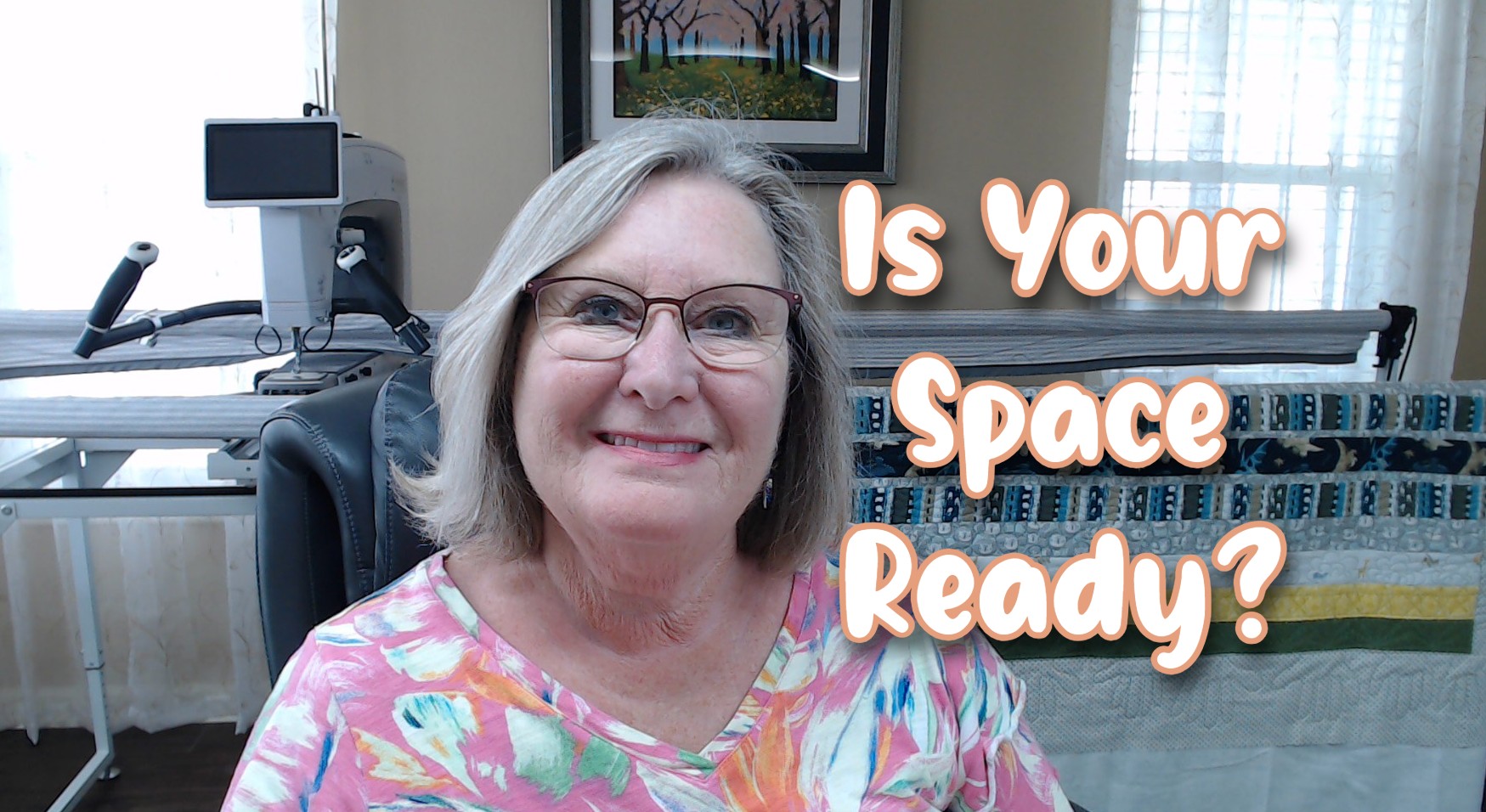
A longarm can feel like the dream, right up until you start wondering where on earth it would actually go. Are you stuck somewhere between wanting a longarm and worrying your house can’t handle it?
Maybe you’re excited. Maybe you’re overwhelmed. Maybe you keep bouncing between “this would be amazing” and “there is no way this could work in my house.” I know that feeling because I’ve been there too, and it’s exactly why I think this question matters more than people make it seem.
Why this question matters
Before I got too far into frame sizes and machine features and all the things that are very easy to get distracted by, I wish I’d slowed myself down sooner. And maybe you need to hear that too if you’re in the middle of researching all of this and trying to make sense of it.
For me, a longarm didn’t feel like just another sewing purchase. It brought up bigger feelings than I expected: whether I was allowed to take up that much space in my home, whether I was being unrealistic, and whether I’d regret wanting something that felt this big. That was probably my first mistake.
I got attached to the idea of the machine before I let myself be honest about what the room would need. Maybe you’ve done that too. You can picture how pretty everything will look and how exciting it’ll feel, but you don’t want to look too closely at the practical side yet because you’re afraid it might take the dream away. I understand that.

Just a little baby quilt with some random quilt designs done with free motion. It was a great opportunity to spend some time working in strips. There was plenty of variety along with a little repetition.
The designs represented something in the fabric’s story.
But if the room isn’t supporting you, that excitement can turn into stress fast. What surprised me most was realizing how many assumptions I had wrapped up in this. I thought a longarm meant you needed some giant picture-perfect studio, and because I didn’t have that, I quietly started telling myself maybe this wasn’t for me after all.
If you’ve ever felt that way, like maybe other people can make this work but you can’t, I want you to know you’re not alone in that. Seeing how other quilters make longarms work in spare bedrooms, shared spaces, basements, garages, and all kinds of creative setups felt like someone had opened a window for me.
What being ready really means
So then the question became, what does ready even mean? At first, I thought it all came down to one thing: do I have enough room? That felt like the safest question to ask, maybe because it was easier than asking the more honest ones. And maybe that’s true for you too.
Sometimes the more honest questions sound like this: will this room support me, will I feel calm in here, and am I creating a setup that fits my real life instead of the version of life I wish I had? For me, a space feels ready for a longarm when it’s easy to move around in, easy to see what I’m doing, and easy to keep organized. I learned that after imagining a setup that might technically fit but would have left me frustrated every time I walked into the room.
And if you know yourself well enough to know that a cramped or chaotic space affects your mood, I think that matters here. You are not just choosing where a machine will go. You are choosing what kind of experience you want quilting to be for you.
That was a big mindset shift for me, and it only happened once I started noticing the flaws in how I was thinking about it. I stopped asking only whether a machine could fit in the room and started asking whether I would enjoy spending time in that room once the machine was there. Those are two very different questions, and learning that probably saved me from making an expensive setup mistake.


Start with the real question: space
One of the most reassuring things I found out, after a lot of overthinking, was that not every longarm setup is huge. Early on, I kept imagining the biggest possible setup and assuming that was just what longarms were like.
But there are smaller options and bigger options, which means it’s not about having the biggest room ever. It’s about finding the setup that makes sense for the room you already have and the way you want to quilt.
Of course, the machine footprint matters, but what really got me thinking was the space around it. That was another thing I almost underestimated. Where would I stand? How would I load a quilt? Would I want to get to the back? Could I still walk around comfortably without feeling squeezed in?
Once I started asking myself those kinds of questions, I could see more clearly where I had been oversimplifying the whole idea. Measuring carefully helped so much, and honestly, I wish I’d done that first instead of later. I mean actually measuring, not just eyeballing the room and hoping for the best, which is exactly the kind of thing I would’ve done at the beginning.
Doors, windows, outlets, closets, and walking paths all ended up mattering more than I expected. A room can seem fine until you imagine actually living with the machine in it every day.
And that part was helpful, because it showed me where my assumptions were off. Once I stopped looking at the room like an empty box and started looking at it like a real working quilting space, it became a lot easier to picture what would make sense and what wouldn’t. That is when the whole idea started to feel less overwhelming and a lot more grounded in reality.
What makes a space functional
From there, the word I kept coming back to was functional. I didn’t want a setup that only technically fit, which I can now see was exactly the trap I was heading toward at first. I wanted one that would make quilting feel smoother and easier, from getting the quilt ready all the way to finishing it.
Storage turned out to be a much bigger deal than I expected, and that was something I would have completely overlooked in the beginning. Just having thread, rulers, bobbins, clamps, and all the little extras within reach makes the whole space feel calmer. Even a smaller room feels better when everything has a home and I’m not digging around for what I need in the middle of a project, which is exactly the kind of chaos I know I’d create for myself.
Lighting was another thing that snuck up on me. It seems obvious now, but it wasn’t one of the first things I thought about. Longarm quilting is such a visual thing, and good light changes the experience.
It is easier on your eyes, easier to see details, and it makes the room feel nicer to be in. I also started noticing all the comfort factors I probably would have overlooked before, like how much reaching I would be doing, whether the floor would be hard on my feet, and whether the machine height would feel comfortable.
A room can fit the machine and still not feel good to use, and I am glad I figured that out before I was fully committed to a setup that looked fine but would have been frustrating. The more I thought about all of that, the more I realized I was not just planning where a machine would go. I was thinking about how I wanted quilting to feel in my everyday life.
And honestly, a lot of that clarity came from noticing where my early thinking had been off and learning from it instead of ignoring it.
Let’s talk about accessibility
That brings me to accessibility, because for me that ended up meaning a lot more than price. At first I treated this like a simple yes-or-no budget question, but underneath that was a lot of emotion. I was asking myself whether I could make space for this in my home and in my life without feeling guilty about it.
And if that part feels familiar to you, I just want to say I don’t think we talk about it enough. Sometimes this isn’t only about money or measurements. It’s also about giving yourself permission to build something that supports what you love.
I was glad to learn that smaller and more flexible setups are a thing. Not everyone starts with a huge dedicated quilting room, and that made me emotional in a way I didn’t expect.
If you’ve been holding yourself to some invisible standard where, if you can’t do it perfectly, maybe you shouldn’t do it at all, I want to gently push back on that. A first setup can be imperfect and still be wonderful. It can open up so much joy. And it absolutely does not have to be your forever setup to be worth creating.
What helped me most was breaking everything down into smaller questions. Measure the room. Figure out what furniture could move. Decide what absolutely has to stay. Think about whether the room needs to do double duty.
Once I looked at it that way, it all felt much more doable, and I stopped treating the whole thing like one big impossible problem. I think that made the biggest difference for me. I stopped seeing it as one giant intimidating decision and started treating it like a series of smaller, manageable ones. That shift probably saved me from rushing into choices that would have looked good on paper but not worked very well in real life.
Real-life ways people make it work
One of the most encouraging things I saw was how creative other quilters are with their spaces. Some use spare rooms, some work around a dining table setup, and some make unexpected spaces work well.
That made me feel like ready does not have to mean perfect. Sometimes it just means you’ve found a setup that works for you, even if it looks different from what you first imagined. And if your sewing room has to be more than just a sewing room, that does not automatically rule anything out.
I think I used to see that as a limitation, but now I see it differently. It just means the space probably needs a little more thought. Good walkways, movable storage, and flexible surfaces can go a long way.
I think that part can be empowering. It turns the room into a puzzle in the best way. You start noticing what could shift, what could be simplified, and what might work better than you first assumed. And if you are anything like me, that’s usually where the best lessons come from anyway.
A simple readiness checklist
So if you’re trying to figure out whether your space is ready, here is the checklist I kept coming back to after realizing how many things I’d overlooked the first time around. And if it helps, you don’t need to have every answer right now. Sometimes just knowing which questions to ask is a good step forward.
- Can I identify a realistic place for the machine and frame?
- Have I measured both the frame footprint and the clearance I need to move around it?
- Can I access the front and at least the necessary working areas of the machine comfortably?
- Do I have enough lighting to see quilting details clearly?
- Is there a plan for storing thread, rulers, notions, and maintenance supplies?
- Will the room support my body with comfortable working height, flooring, and movement?
- Can this setup fit my current lifestyle, even if it is not my forever layout?
- What can I simplify, remove, or rearrange to make the room function better?
If most of your answers are yes, you might be a lot closer than you think. And if some answers are no, that’s still useful information. That’s where the learning happens.
If you’re noticing parts of this that feel uncomfortable or disappointing, I want to remind you that seeing clearly is not a failure. It is such a loving thing to do for yourself and for your quilting. It helps you see what will truly support you instead of what only sounds good in your head.
Final thoughts
So, is your sewing space ready for a longarm machine? For a lot of us, the answer isn’t a simple yes or no. It’s more like maybe—with some honesty, a little creativity, and a setup that works for real life. And I think that’s okay.
If you’re in that in-between place, still thinking it through, still measuring, still second-guessing, that doesn’t mean you’re doing it wrong. It probably means you’re paying attention in the exact way this decision deserves. Sometimes readiness looks less like certainty and more like being honest about what will support you, your space, and the way you actually want to quilt.
What I keep coming back to is this: a longarm setup starts to feel possible the moment you stop chasing perfect and start paying attention to what is workable, supportive, and true for your life right now. A beautiful machine is more enjoyable when the room supports it. And if you’ve been caught between wanting this and doubting whether you’re allowed to want it, I know that feeling. You deserve to look at your space with honesty and kindness and build something that supports both your quilting and your everyday life.
So if you’ve been dreaming about a longarm but feeling unsure about the room part, I hope this helps you trust yourself a little more. That was me too. If there is one thing I would want to leave you with, it’s this: don’t rush past the room questions just because they feel less exciting than the machine itself.
Pay attention to how you want the room to feel. Pay attention to what will make quilting easier, calmer, and more sustainable for you. And if you’re still figuring it out, that doesn’t mean the dream is out of reach. It may just mean you’re building it in a way that will truly fit your life when it gets there.
You must be logged in to post a comment.